Scholarship Application Form
Horticulture Society of Balochistan (2026)
Note: Ensure all fields are filled. The last date for submission is June 15, 2026.

Proximate and nutritional attributes of sabzo date palm fruit from Panjgur, Balochistan as affected by various drying methods.
Zain-ul-abbideen 1, Sami Ullah 1, *, Gulzar Akhtar, Nazar Faried, Kashif Razzaq, Ishtiaq A. Rajwana1,
1 Department of Horticulture, MNS-University of Agriculture, Multan
2 Affiliation 2; e-mail@e-mail.com
* Correspondence: sami.ullah1@mnsuam.edu.pk; Tel.: (optional; include country code; if there are multiple corresponding authors, add author initials)
Abstract: Date palm (Phoenix dactylifera. L) thrive in areas having high temperature and low humidity. However, in date palm core production areas of Pakistan, to avoid fruit losses, due to prevalence of early wet ‘Monsoon’ rain seasons at fruit maturity force growers to harvest fruit prematurely for drying, affecting quality. Therefore, a study was planned to evaluate the effect of monsoon rainfall on dates through various drying methods of date palm fruit on quality of fruit at two fruit maturity stages: ‘Khalal’, early fruit maturity and ‘Rutab’, Mid fruit maturity stage. Further, fruit were subjected to drying methods ‘Sun-drying’, ‘hot-air drying’ and ‘freeze- drying’ at both stages of cv. ‘Sabzo’. The results reveled that the fruit dried through freeze drying at both fruit maturity stages exhibited better physical, biochemical, antioxidative and proximate attributes than other drying methods. Date fruit dried through freeze drying exhibited higher fruit total soluble solids (25.19°Brix), juice pH (6.18%) and titratable acidity (0.56%), moisture content (5.15g/100g), ash percentage (6.63g/100g), crude fiber (12.02g/100g), fat content (23.63g/100g), Carbohydrate (50.2g/100g), crude protein (9.06g/100g) and calories (1724.23Kcal/100g). fruit aroma (7.96), color (8.37), taste (8.53), texture (8.23) and flavor (8.37). Antioxidative enzymes; superoxide dismutase (4.05 Umg-1 protein), catalase (20.13 U mg-1 protein). Phytochemicals; carotenoids (3.02 mg GAE/100g), total phenolics (333.73mg GAE/100g). Conclusively, Freeze-drying at Rutab stage emerged as the most effective method for retaining higher quality attributes of ‘Sabzo’ date palm fruits ultimately retained nutritional and health benefits of dried fruit.
Keywords: Date palm, ‘Monsoon ‘rain, dehydrating techniques, Panjgur
Self-Watering Container Gardens: An Efficient Cultivation System
Self-watering container gardens offer a highly efficient and convenient method for cultivating plants, significantly reducing the demand for frequent manual watering. This innovative system operates on the principle of capillary action, providing a continuous and consistent supply of water directly to plant roots. Each garden is comprised of several key components working in unison: a container to house the system, a specialized growing medium for plant growth, a dedicated water reservoir at the base, and wicks that draw water from the reservoir into the growing medium. A geotextile layer prevents soil from entering the reservoir, while a fill point allows for easy refilling and an overflow valve prevents overfilling. Drainage holes in the growing medium ensure that excess water can escape, preventing waterlogging and root rot.
The system's operation is elegantly simple: the reservoir is filled, wicks draw water upwards, the growing medium absorbs this moisture, and plants access water as needed. This ingenious design offers numerous benefits, including a reduced need for frequent watering, improved water efficiency due to direct root delivery, and a lower risk of overwatering. Consequently, plants experience enhanced growth and overall health. Self-watering container gardens are particularly ideal for busy gardeners seeking a low-maintenance yet effective solution. To maximize their potential, it's crucial to select the right container size, use a well-draining growing medium, monitor water levels, and provide regular fertilization.

EXPLORING THE VALUE ADDITION OF DATE PRODUCTS IMPORTANCE AND FUTURE SCOPE OF MAKRAN, BALOCHISTAN.
1Department of Horticulture, MNS-University of Agriculture, Multan 60000, Pakistan
*Corresponding author. Email: zainbaloch.offical@gmail.com
Zain-ul-abbideen*1, Sami Ullah1, Adnan ali1
Abstract
This study aimed to evaluate the quality and consumer acceptability of four traditional date-based products prepared using locally harvested dates in Panjgur, Balochistan. The products included Mathari Nah with Cooking Oil, Mathari Nah with Coconut Powder, Gun Poos Mathari Nah, and Changali Nah. Organoleptic attributes such as aroma, color, taste, texture, and flavor were assessed by a panel of evaluators using a 9-point hedonic scale. The results revealed significant variations in sensory scores across the products. Gun Poos Mathari Nah received the highest scores for aroma (7.42), color (7.42), taste (7.42), and flavor (7.44), indicating its superior quality and overall acceptability. Meanwhile, Mathari Nah with Coconut Powder excelled in texture with the highest score of 8.12. Comparatively, Changali Nah and Mathari Nah with Cooking Oil received moderate to low scores across all parameters, with Mathari Nah showing the least favorable results. This research highlights the potential of traditional date-based products to meet consumer preferences and emphasizes the importance of enhancing sensory qualities for broader market acceptance.
Introduction
The monocotyledonous date palm (Phoenix dactylifera) is a perennial, dioecious plant that belongs to the palm family, Arecaceae (or Palmae). It is primarily cultivated in arid regions of the world and holds significant importance in the agricultural economies of many nations. The date palm is renowned for its remarkable ability to thrive under extreme environmental conditions such as high temperatures, minimal water availability, and high soil salinity, making it a symbol of life in arid and desert areas.
A well-managed date palm tree can yield up to 200 kilograms of fresh dates annually, although the tree typically begins to fruit within 2 to 4 years and reaches its maximum production capacity in 5 to 8 years. The date fruit is oval-shaped, containing a single seed enclosed within a succulent pericarp. The fruit's weight ranges between 2 to 6 grams, with dimensions varying from 18 to 110 mm in length, and it comes in a variety of colors (from yellow to black) and flavors. The seeds, also referred to as pits, stones, or kernels, are oblong and hard-coated, weighing between 0.5 to 4 grams.
Nutritional and Health Significance
Dates are recognized as a nutrient-dense fruit with a broad spectrum of essential nutrients that provide significant health benefits. Consuming dates alongside other food components has been shown to improve human health in various ways. Dates are considered a supreme food due to their high nutritional value and environmental benefits. They hold immense potential in improving diets, particularly in regions where they are consumed as a staple or delicacy.
Economic and Technological Importance of Date Byproducts
Extensive research has been conducted on date byproducts, which include jams, pickles, and date gum. In food technology, date syrup is one of the most frequently produced and widely utilized derivatives. It serves as a base ingredient in the preparation of honey, chocolates, ice cream, jams, marmalades, and concentrated beverages. Certain date varieties, such as the Kabkab date, often yield significant waste; however, utilizing this waste for date syrup production offers substantial financial benefits.
Cultural and Historical Significance
The date palm holds deep cultural and historical value, particularly in the Near East and North Africa. It has played a pivotal role in sustaining human life in arid regions for thousands of years and remains an integral part of the traditions and culture of the people residing in these areas. The Holy Qur'an mentions the date palm twenty-five times, further elevating its cultural and spiritual importance. The Prophet Muhammad (peace be upon him) referred to the date palm as a "blessed tree", encouraging its consumption. During the holy month of Ramadan, it is a longstanding tradition to break the daily fast at sunset with a few dates, followed by small sips of water.
Global Production and Distribution
Globally, the date palm is cultivated across 37 countries, with approximately 2000 different varieties of date palm identified. According to estimates from the Food and Agriculture Organization (FAO) and FAOSTAT, date cultivation spans around 0.1 million hectares of agricultural land, yielding an approximate annual production of 0.9 million tonnes. However, variations in global date production occur due to factors such as trade embargoes, political unrest, and fluctuations in growing conditions from one season to another.
Production of Pakistan
Pakistan is among the leading date-producing countries, contributing significantly to global production. The date fruit's size, shape, and quality differ across regions, reflecting the diversity of cultivation practices worldwide. All four of Pakistan's provinces are involved in the country's extensive date production. at terms of date production, Khyber Pakhtunkhwa, Sindh, Punjab, and Balochistan are at the forefront. Balochistan's main date-producing districts are Panjgur, Turbat, Pasni, and Kech. The goal of this study is to examine the economics of the date palm value chain in the turbat region of Makran Division, Balochistan, which is well- known for producing Pakistan's finest dates. The district Panjgur, Kech, and Gawadar are included in the Makran Division, which has a total area of 26,000 km². turbat is comprised of areas like hoshab, singani sir, Samee, tajaban, padraq, and many other parts. turbat district grows a variety of dates Begum Jhangi. Konzenabad, muzawati, Kungo, Dandari, Aseel, Dakki, Halini, Rogini, Dishtari are also included. Furthermore, Kech district is an important date palm producing area, accounting for 45% of Balochistan's total date palm farming area. Even if the climate in the kech district is ideal for date palm cultivation, the yields per hectare are not as high as what the varieties of date palms that are already in use can produce. Moreover, farmers still employ time-consuming, labor-intensive, centuries-old agricultural practices, which increase production costs and lower net returns. In light of these worries, the current study was conducted in District Panjgur, Balochistan Province, Pakistan, to look at the date palm industry's economics and constraints (Government of Balochistan, 2009).
Materials and Methods
Study Area
The research was conducted in Panjgur, Balochistan, a region known for its rich date palm cultivation. The study aimed to assess the quality and acceptability of various date-based products through organoleptic evaluation. four distinct date-based products were prepared using locally harvested dates. The products were developed as follows:
Mathari Nah with Cooking Oil
Mathari Nah with
cooking oil is a traditional date product made locally in the Makran division. The preparation involves extracting and removing the
seeds from the date pulp. The dates are then mixed with wheat flour in the
ratio of 1 kg of dates to one paw (approximately 250 grams) of wheat flour,
along with 300 grams of cooking oil.

The process begins
by thoroughly mixing the date pulp with the wheat flour, either using a mixer
or by hand. Once the mixture is ready, it is roasted in cooking oil for about
20 mints. The roasting continues until the date mixture separates from the
cooking oil and becomes fully roasted. This delicacy is locally known as Mathari
Nah with Cooking Oil and is a popular traditional food in the region.
Mathari Nah with
Coconut Powder
Mathari Nah with coconut powder is a traditional date product made locally in the Makran. The preparation begins with extracting and removing the seeds from the date pulp.
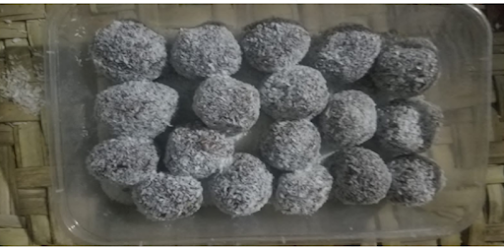
The dates are then
mixed with wheat flour in the ratio of 1 kg of dates to one paw (approximately
250 grams) of wheat flour. Additionally, 300 grams of desi ghee (clarified
butter made from milk) is used in the process.
The date pulp is
first mixed with wheat flour, either using a mixer or by hand. The mixture is
then roasted in the desi ghee for about 20 mints, ensuring the date mixture
separates from the ghee and becomes fully roasted. To enhance the product's
appearance and add a unique touch, approximately 50 grams of coconut powder is
dusted over the mixture, giving it a cosmetic and appealing look.
Gun Poos Mathari
Nah
Gun Poos Mathari Nah
is a traditional date product made locally in the Makran division, particularly
in Turbat. The preparation starts with extracting and removing the seeds from
the date pulp. The dates are then mixed with wheat flour in the ratio of 1 kg
of dates to one paw (approximately 250 grams) of wheat flour. Additionally, 300
grams of desi ghee (clarified butter made from milk) is used in the process.

A unique feature of
this recipe is the addition of “Gun” a locally prepared mixture (known as Gun
in Balochi and Shnna in Pashto). About 300 grams of this ground mixture
is prepared using a grinder and then combined with the date and wheat flour
mixture.
The combined mixture
is roasted in the desi ghee for about 20 mints until it separates from the ghee
and becomes fully roasted. To further enhance its appearance and flavor,
approximately 50 grams of sesame seeds are sprinkled over the mixture, giving
it a polished and visually appealing finish.
Changali Nah
Changali Nah is a
traditional date product made locally in the Makran division, particularly in
Turbat. The preparation involves extracting and removing the seeds from the
date pulp. The dates are then mixed with fresh bread in the ratio of 1 kg of
dates to (approximately 2-3 beads). Additionally, 1 kg of desi ghee (clarified
butter made from milk) is used in the process.
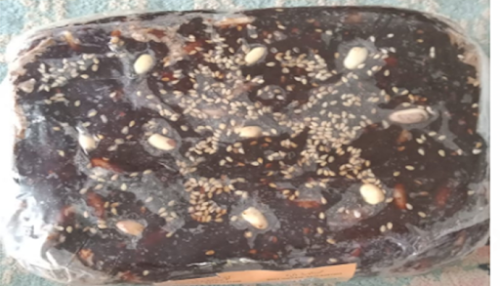
The date pulp is first combined with fresh bread either using a mixer or by hand. The mixture is then roasted in desi ghee for about 20 minutes, ensuring the date mixture separates from the ghee and is fully roasted. To add a unique touch and enhance the product's appearance, approximately 50 grams of fresh ajwain seeds are sprinkled over the mixture, providing an appealing look and subtle aroma.
Organoleptic attributes result

The comparison of colors revealed that Gun Poos Mathari Nah had the highest
score, with a rating of (7.42), followed by Coconut Powder at (6.82). Changali
Nah was more bitter than Mathari Nah, earning a score of (5.8). The lowest
score was for Mathari Nah, with a rating of (4.01). Overall, Gun Poos Mathari
Nah achieved the best result.
Fig no 2: Comparisons of Color of the Mathari Nah with cooking oil, Mathari Nah with Coconut Powder, Gun Poos Mathari Nah and Changali Nah.

The comparison of colors showed that Gun
Poos Mathari Nah had the highest score of (7.42), followed by Coconut Powder
with a score of (6.82). Changali Nah had a lower score of (5.8), which was more
bitter compared to Mathari Nah. The lowest score was recorded for Mathari Nah,
with a result of (4.01). Overall, Gun Poos Mathari Nah gave the best result.
Fig no 3: Comparisons of Taste of
the Mathari Nah with cooking oil, Mathari Nah with Coconut Powder, Gun Poos
Mathari Nah and Changali Nah.

In the comparison of taste, Gun Poos
Mathari Nah achieved the highest score (7.42), followed by Mathari Nah with
Coconut Powder, which scored (6.72). Changali Nah performed better than Mathari
Nah, scoring (5.6), while Mathari Nah had the lowest score (4.00). Overall, the
best taste result was recorded for Gun Poos Mathari Nah.
Fig no 4: Comparisons of Texture of
the Mathari Nah with cooking oil, Mathari Nah with Coconut Powder, Gun Poos
Mathari Nah and Changali Nah.

In
the comparison of texture, Mathari Nah with Coconut Powder achieved the highest
score (8.12), followed by Gun Poos Mathari Nah with a score of ( 7.52).
Changali Nah performed better than Mathari Nah, scoring (6.64), while Mathari
Nah had the lowest score (3.98). Overall, the best texture result was observed
in Mathari Nah with Coconut Powder.
Fig no 5: Comparisons
of Flavor of the Mathari Nah with cooking oil, Mathari Nah with Coconut Powder,
Gun Poos Mathari Nah and Changali Nah.

In the comparison of
flavor, Gun Poos Mathari Nah recorded the highest score (7.44), followed by
Mathari Nah with Coconut Powder, which scored (6.82). Changali Nah performed
better than Mathari Nah, scoring (5.04), while Mathari Nah had the lowest score
(4.03). Overall, the best flavor result was achieved by Gun Poos Mathari Nah.
Conclusion
The present study successfully evaluated the organoleptic attributes of four traditional date-based products from Panjgur, Balochistan. The findings demonstrate that Gun Poos Mathari Nah was the most preferred product, scoring highest for aroma, color, taste, and flavor. Its preparation process, which includes the addition of a locally prepared mixture (Gun) and sesame seeds, contributed to its superior sensory appeal. Mathari Nah with Coconut Powder also performed well, particularly in texture, due to the inclusion of coconut powder and desi ghee, enhancing its consistency and mouthfeel.
In contrast, Changali Nah and Mathari Nah with Cooking Oil received lower scores, indicating a need for recipe refinement to improve sensory attributes, particularly taste and texture. This study underscores the value of preserving and improving traditional food products to promote local culinary heritage while enhancing their marketability. Future research could focus on nutritional analysis, shelf life, and consumer perception across a broader demographic to further validate the acceptability of these date-based products.
STUDY OF TRACE ELEMENTS IN FRUITS OF DATES AT TURBAT-PUNJGURREGION OF BALOCHISTAN WITH REFERENCE TO MEDICINAL AND ENVIRONMENTAL POLLUTION
Asif Khan1, Manzoor Iqbal Khattak1\*, Rukhsana Jabeen2, Saadullah Khan Laghari3, Yasir Arafat1
1 Department of Chemistry, Balochistan University, Quetta, Pakistan
2 Sardar Bahadur Khan Women University, Quetta, Pakistan
3 Department of Chemistry, Balochistan University, Quetta, Pakistan
Corresponding author's email: manzoor_iqbal@yahoo.com
Abstract
This study focuses on the status of dates in Balochistan and the analysis of heavy elements (Boron, Copper, Chromium, Cadmium, Iron, Lead, Manganese, Nickel, and Zinc) in the fruits of dates grown in the Turbat-Panjgur region. Dates are a vital fruit crop in Pakistan, grown on an area of 23,880 acres, with significant production in Balochistan and Sindh. These dates are essential for domestic and international markets, especially organic ones.
The study advocates adopting biological standards to enhance the export quality of dates, emphasizing both medicinal benefits and environmental protection. Investigations using mass spectrometry-induced coupled plasma (MS-ICP) showed most trace elements were present in small quantities, except for Iron (Fe), Nickel (Ni), and Zinc (Zn), which could originate from geological and water sources. These elements' absorption by plants has medicinal applications and helps mitigate environmental pollution.
Keywords
Dates, Trace Elements, Medicinal Plants, MS-ICP, Environmental Pollution
The Scenario of Date Palm Cultivation in Makran,Balochistan
1Department of Horticulture, MNS-University of Agriculture, Multan 60000, Pakistan
*Corresponding author. Email: shafa.nayab@mnsuam.edu.pk
Adnan Ali1, Sami Ullah1, ShafaNayab*1,Zain-ul-abbideen1
Date palm (Phoenix dactylifera)is a fruit that has long been prized in Islam. Remains of date trees have been discovered at Neolithic sites dating back 7,000–8,000 years in Syria and Egypt. When Arabs came to Makran, Balochistan they carried dates fruit with them. They used dates for consumption and the seeds of these consumed dates naturally initiated the date fruits in the Makran region. Nowadays, date palms may be found in a number of hot, dry locations around the globe, including deserts in subtropical zones. Because they are consumed in large quantities all around the world, they have significant economic worth.


Nutritional Importance
Dates are a very nutrient-dense fruit that have a high percentage of carbohydrates (70%) and are a significant source of sugars, vitamins, minerals, and trace amounts of fats and proteins. Additionally, it has K and very little Na levels, making it suitable for those with hypertension. They are a significant source of carotenoids, phenolic compounds, antioxidants, sterols, anthocyanins, procyanidins, tannins, and flavonoids, among other phytochemicals.
Dates Production in Pakistan
Pakistan is the sixth-largest producer of dates, with 0.05 million tonnes produced annually on 0.09 million hectares of land. The province that produces the most dates, Balochistan, accounts for 77% of the total fruit output; Sindh, Punjab, and KPK follow. The majority of the date palms in Balochistan are found in districtTurbat, Panjgoor, Khuzdar, Bolan, Gwadar, and many other districts. Makran division, which produced the majority of the date palm fruit. As a result, the Makran region's economy depends heavily on date palm.
Best Varities of Date Palm in Makran
Most common varieties of date palm in Makran are Begum Jangi,Sabzo,Halini, Konzenabad, Abdandan, Muzwati,Goknah, Rogini, Hussaini, Dishtari,Pashpag, Dandari, Shakri, Aseel, Kungo ,Jaan, Sware, Karaba , Rabbi,Shakarok, Dakki, peshnah, hussani, etc.
Common Insects and Diseases
Common diseases and insects of date palm in Makran include Diplodia and Bayoud disease, Fusarium wilt, Dubas bug, and root knot nematodes. Diplodia disease is caused by Diplodiaphoenicum and has been recorded on 20 date varieties worldwide. Bayoud disease is caused by Fusarium oxysporum f. sp. albedinis and is a deformed growth of date palm vegetative buds. Fusarium wilt is caused by Fusarium oxysporum f. sp. canariensis and is a lethal vascular disease of Canary Island date palm. Dubas bug (Ommatissuslybicus) is an economically significant pest of date palms, and root knot nematodes (Meloidogynearenaria and Meloidogynehapla) cause root knot disease.

Major Problems of Date Palm in Makran
The first major problem for the farmers of this region is that the monsoon rain coincidence with ripening of dates. The farmers who try to get date early in order to destruction due to rain or infestation, have to sell them to agent, middle man and business entities in low prices due to the lack of storage and processing units facilities. Local farmers are not aware of benefits of processing units and they have not been provided with required infrastructure support. Due to the unavailability of cold storage system, most of the farmers of this region store dates in open areas/gardens, consequently a huge amount of date spoiled in garden due to microbial contamination.
Possible Solutions
Government should gear up R&D in the region, provide processing unit and cold storage rooms, promote solar drying techniques, develop packaging standards and market linkages, quality control and certification to the related areas and improved supply chain system. Moreover, awareness should be spread among the farmers about correct methods and dose of using fertilizers and insecticides by which quality production will be ensured that contribute to increase GDP. By implementing these practices, Makran can significantly improve dates storage practices, reduce post-harvest losses, and enhance the economic prospects of local date palm farmers and small businesses.
*Corresponding author. Email: shafa.nayab@mnsuam.edu.pk